AICE Lab
Atomistic Intelligence for Catalysis and Energy
Atomistic simulations and AI for energy materials and catalysis.
We develop ML-driven simulation methods to understand how materials behave under real operating conditions.
Artificial Intelligence and Atomic Simulation for Catalysis and Energy, led by Dr. Seokhyun Choung. Real catalysts operate at dynamic interfaces, where surfaces restructure mid-reaction and particles reorganize under working conditions. We tackle these problems with AI methodology: generative models, agents, and large language models, coupled with atomistic simulation to solve the dynamic-interface problems of catalysis and energy.
Experiment as Ground Truth
"No matter how beautiful the theory is."
- R. Feynman (1964)Adopt AI Responsibly
Take responsibility for the quality of AI-generated outcomes.
AI Multi-Agent System for Material Discovery
Multi-agent systems that run the discovery cycle end to end: propose, simulate, analyze, and decide the next experiment. LLMs, generative models, and simulation tools orchestrated into autonomous workflows.
ICLR 2026 AI4MatChem. Eng. J. (2024)
ACS Energy Lett. (2025)
MLIP AI Infrastructure for Material Discovery
Foundation-model potentials adapted to target systems with minimal DFT data, compressed into fast and accurate MLIPs for large-scale simulation.
AI4Mat-NeurIPS (2025)Cell Rep. Phys. Sci. (2025)
Nat. Sensors (2026)
Operando Simulation for Real-world Impact in Collaboration with Experiment
MLIP molecular dynamics at realistic operating conditions, compared directly with in-situ experiments (XAS, DRIFT, TEM). 17+ experiment-theory co-publications.
Nat. Commun. (2026)Nat. Commun. (2026)
Appl. Catal. B (2026)
For Your Research
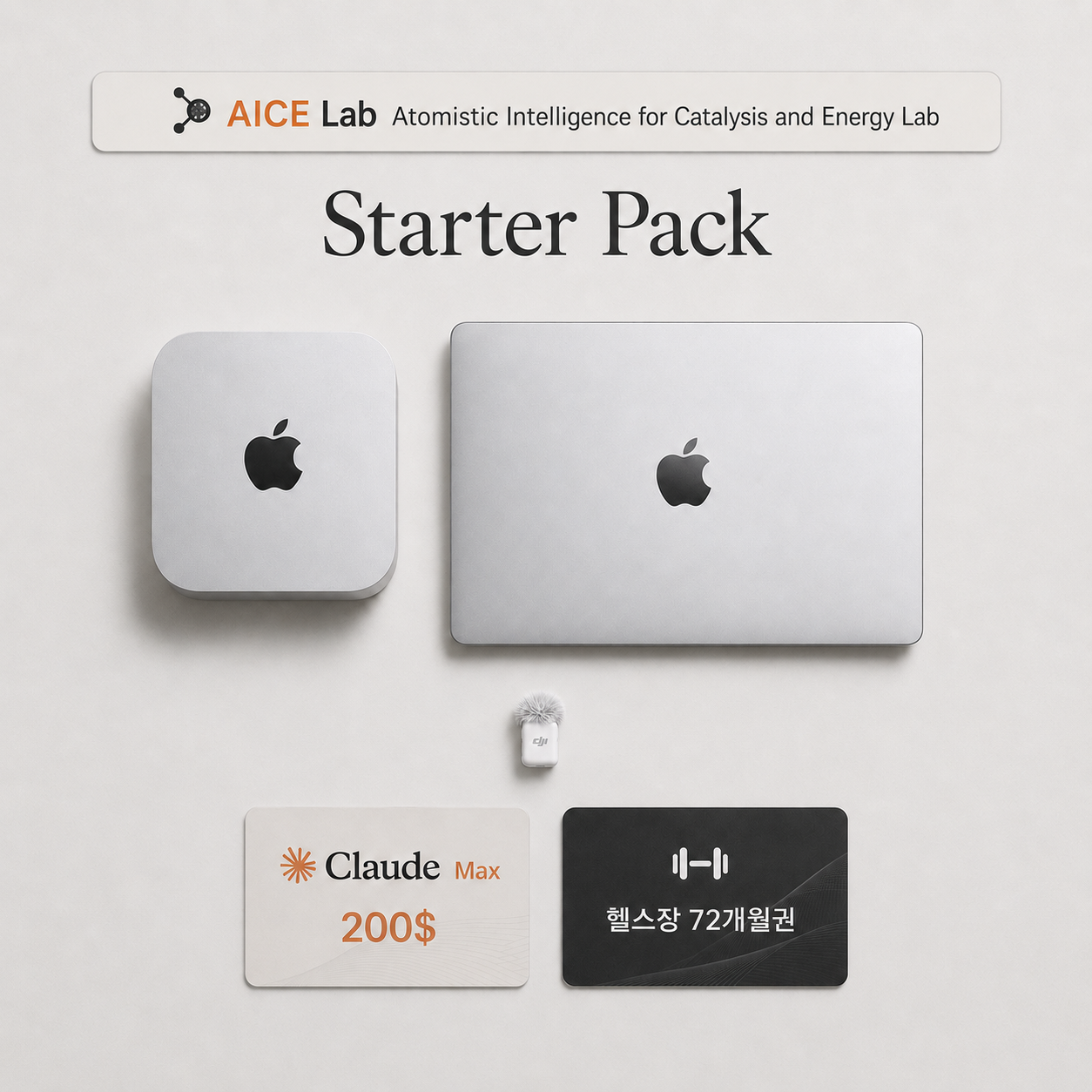
- Claude Max for every lab member
- GPU clusters (A6000/L40S, H100 via KISTI)
- VASP, LAMMPS, PyTorch, ASE, custom tools
- Direct experimental collaborator connections
For Your Life
- Gym membership (we pay for it)
- Flexible working hours (output > hours)
- Unlimited deep discussions with Dr. Choung
- 1-on-1 mentoring for YOUR career goals
- Asking "why?" is encouraged, not punished
Interested?
Graduate students, postdocs, and undergrads all welcome. No simulation experience required.
No formal deadline. Positions open until filled.